Chapter 7 Our Diet Now
Towards the end of 2020, we had an outdoor get together with some very close friends and as we were sitting around the fire pit chatting and laughing one of our friends said “bring the brinjals, lets grill them so that you can make a baingan ka bharta tomorrow!”. the “Baingan ka bharta” is a delicacy made with grilled minced eggplant. So, we got two brinjals, they were grilled and the next day we did make the “bharta”, ate it with crisp tawa rotis and green chillies. It tasted divine. The reason I mention this is that after about 8 months of eating what was essentially a high protein, high fiber and low carb diet, we were slowly but surely wanting to get back to traditional food that we had eaten most of our adult lives and our parents and grandparents had eaten most of their lives. Eating the bharta that day reminded us that we missed our traditional Indian food more than we realized.
As more months went by, roti, rice, pulses cooked in a pressure cooker and cooked vegetable curries became more and more a part of our dinners like they had always been. We still love our grilled veggies and chicken though and eat it multiple times a week. The lunch for us is still one of our favorite salads on most days. The breakfast, however, is what is the most different because the “lunch” is the “breakfast”. Allow me to explain.
7.1 The breakfast that isn’t
When we started training, and our trainer mentioned the 30-day challenge, she also mentioned something that we simply ignored (one of the rare things that she said and I just forgot). It was that she did not eat breakfast or said another way her first meal of the day with which she broke her overnight fast (break-fast) was lunch.
It did not even occur to me that it was something to consider, I did not pay much attention to it at all. As I became more interested in nutrition and ageing and longevity, I started hearing more and more about intermittent fasting. There are two schools of thought, one that says you should keep eating small meals multiple times a day and another one which says you should eat two or three full meals a day and no snacks. I can only speak from what I experienced, eating full meals and no snacks works best for us. Just to state it again, whatever I am writing here is not medical advice, please consult your doctor before starting any new diet or exercise and confirm that it is appropriate for your specific situation and life circumstance. Children should not skip breakfast; my kids eat a healthy breakfast early in the morning.
By intermittent fasting, I mean a 12 hour fast and a 12-hour eating window OR a 14 hour fast and a 10-hour eating window OR a 16 hour fast and an 8-hour eating window. Depriving oneself of any and all foods that one likes during the week and then gorging on all sorts of unhealthy foods over the weekend is not my idea of intermittent fasting. I started with a 12-12 fasting and eating window and have now comfortably settled into a steady 16 hour fasting and 8 hour eating window and it works great for my body and mind. I prefer intermittent fasting over the eating 6 meals a day routine for several reasons that I list below.
Eating clean and healthy 3 times a day is difficult as is in a modern city based lifestyle, eating clean and healthy 6 times a day is almost impossible unless you are an athlete or a movie star and have someone on your staff whose job is to take care of your nutrition. I just don’t trust myself to make the correct choice for food 6 times a day, every day.
All weight loss is ultimately a game of keeping the insulin levels in your blood within a narrow range. Eating multiple times a day means blood sugar levels will increase in response to the carbs being broken down into glucose and that means the pancreas will produce insulin.
I feel bad while writing this, but I cannot deny that not having to prepare and eat breakfast is a decent 30 minutes of time saved at the start of the day. While this should not be a factor, but the reality is that it is. I like to use those 30 minutes for my morning walk, for reading a book and sometimes for replying to some quick work-related emails.
All my adult life I had eaten three full meals a day, the idea that there is no breakfast was so much out there that even until a few months ago I used to think that if you do not eat breakfast how do you even function! Not anymore. I feel fantastic with my 16-8 routine. I realized that often times when due to some work related crisis in the morning I could not eat breakfast until noon, my brain actually worked much better, now it could simply be a result of being very focused on the problem but it was definitely something I considered when trying intermittent fasting.
While I do not eat breakfast, but I do take my morning coffee (no cream or sugar), sometimes with 10 to 15ml of MCT oil added to it to make it the so-called Bulletproof Coffee. The MCT oil provides the fat which they say gives you energy, clears brain fog and has other benefits. I am not so sold on the benefits; I do take it every now and then. Recently though, instead of the morning coffee I have started taking microgreens, available as powder that you can just mix in cold water and drink and then take my coffee an hour or so later at the start of my workday. This arrangement works much better for me. The microgreens help provide several essential pre and postbiotics, vitamins and minerals. I have seen several nutritionists recommending not to take coffee right after walking up. Drinking coffee on an empty stomach could cause gut health issue, change the Cortisol production cycle, so I am happy that have shifted my coffee intake to about two hours (or sometimes even more) after waking up. While on the topic of caffeine, I don’t drink coffee after 3pm and rarely, if ever, after 4pm. Here is a picture of the microgreens drink, first thing in the morning.
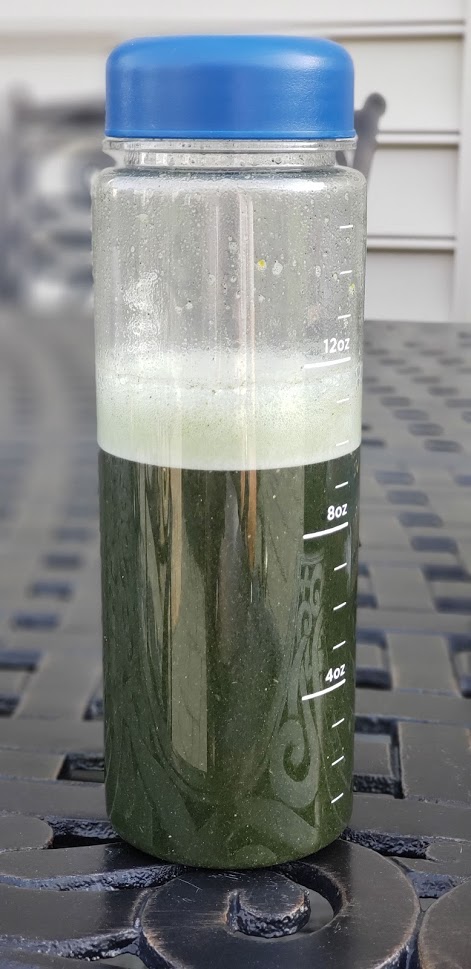
Microgreens
7.2 The lunch
One thing that has relatively stayed the same, and which also explains the unchanged name of this book, is the lunch salad, of course with blueberries. It is still something we greatly enjoy eating. The fact that it is something that is healthy and tastes good means that there isn’t any need to change it. I mean why fix something that is not broken? Our lunch is usually around 1pm.
The salad still consists of a healthy dose of cruciferous vegetables such as a kale, broccoli sprouts, cabbage, arugula, brussels sprouts. The benefits cruciferous vegetables are well documented in terms of their antioxidant and anti-inflammatory effects. These vegetables are also good source of fiber and vitamins. There is some research that show that cruciferous vegetables decrease inflammation and reduce the risk of cancer.
We have had two additions to our salad: Broccoli sprouts and Hemp seeds. I learnt about the benefits of broccoli sprouts in a Podcast that I listen to and when I saw them in a local supermarket, I immediately decided to try them out. So now our salads often contain a few grams of Broccoli sprouts (they have a very small (fridge) shelf life). These wonderful sprouts contain glucoraphanin which our bodies convert into a compound called sulforaphane that helps in fighting cancers, ulcers and even supposed to have mental health benefits. Hemp seeds are a great source of plant-based protein, essential fatty acids and some vitamins and minerals. We use it off and on in our salads. More discerning readers would know that hemp seeds contain trace amounts of THC (< 0.3%), the active compound in marijuana. I suppose the jury is still out on the inclusion of hemp seeds into functional foods.
There is a growing interest in using plant based chemical compounds for improving cellular defense mechanism and we just feel happy about making the good choices wherever we can.
Eating salads, so consistently has been a very distinct shift from our eating habits growing up. While we always were aware of the idea that eating raw uncooked vegetables is beneficial but then how much of raw vegetables could you consume. Growing up, my lunch used to have cucumber, radish, cabbage and onion as salad but it was an adjunct and that too not every day and slowly as I went for higher studies, entered professional life, the amount of raw uncooked vegetables I consciously consumed just kept on reducing. Whereas now, a hearty salad, rich in fiber, proteins and good fats, that completely fills us up is our lunch at least five days a week. The lunch salad is probably the most fundamental and probably the most beneficial change in our diet. Nowadays, if I eat a heavy lunch such as a high carb lunch at a restaurant or sometimes even at home then within an hour or so of eating the lunch the familiar old feeling heaviness, lethargy and sleepiness returns. I am now so used to maintaining constant energy levels through the day that feeling sleepy in the middle of the day, is just, terrible. Sometimes when meeting friends or at social events people give me the reaction that “oh, you are doing such a great job of watching what you eat, what a sacrifice to make for good health!” and I must explain to them “actually, no, it is not at a sacrifice at all, what it is that now I don’t want to trade 3 hours of feeling sub-optimal for 20 minutes of taste, that is all…”. This body is not a loaner!
Well, as it turns out, the salad is not the end of our lunch. To top it off, I usually take a protein bar (we choose one of the bars that has minimal ingredients) or sometimes a spoonful of Moringa powder with water after the salad. It does not taste good, but boy is it beneficial! Moringa Olifera is a widely grow in Asia and Africa and is native to North Western India, the exact part of the Indian subcontinent from where my grandparents came. It is interesting that when I was describing Moringa to my mother, she mentioned to me that my grandfather used to get that plant often as a vegetable to be had as part of lunch. Moringa is called Sehjan in Hindi. It has several documented health benefits such as being good for digestion, helps with medical conditions such as high blood pressure, diabetes, obesity etc. But the one health benefit that I noticed right from the first day was that it helps keeps my insulin levels constant and energy levels up. Now, I do not have a continuous glucose monitor (CGM), not yet anyway, to be able to prove it with data but I certainly think that is the case.
On days when I don’t have Moringa powder after lunch, I take a black coffee along with my protein bar. This is my last cup of coffee for the day.
7.3 The 4pm snack
As you might have guessed, I no longer feel the need for it. The fiber, proteins and good fats from the lunch keep me full. I do take a caffeine free tea anytime between 3.30pm to 5pm. Sipping a hot beverage helps me focus better, although the documented benefits of sipping hot water (I would like to consider the caffeine free tea to just be flavored hot water) are that helps with digestion, triggers the endocrine system, even helps the muscles relax, but I will go with “it helps me focus better post lunch”.
7.4 Dinner
I get back home from work around 6.30pm (I started going back to work soon after I got my second Covid vaccine shot) and at that time I am hungry. I will admit, that before dinner I do end up snacking, could be a few apricots, a couple of figs or very occasionally a slice of frozen grain bread (toasted before eating) with kerrygold butter. This is not ideal, but then, it is better than eating unhealthy snacks.
Ideally, I would like the dinner to be between 7 - 7:30pm but it is more like 7:30 - 8:30pm. We need to pull it back. The dinner has changed since last year. The high protein grilled stuff that we had been eating is now mostly replaced with a conventional North Indian dinner which includes carbs, fat and some protein (in that order). Until a few months ago when I was still shy of my weight target, I used to be very careful about avoiding carbs, but no more. My weight has been stable between 185lb to 190lb for several months now, and that has been with a dinner that contains carb in the form of Rotis and cooked vegetables, fats in the form of Ghee and proteins either from chicken or fish or pulses.
It was in February 2021, almost one year after we switched to a high protein low carb diet, that I started noticing that I could not sleep through the night. I used to wake up around 2 or 3am and then go back to sleep after 15 minutes or. This disrupted sleep meant that I did not wake up energized the next morning. I discussed this with my trainer and did some google search and found out that this was probably happening because I was not fueling my body with enough carbs. Eating a full dinner, not late in the evening of course (although 7.30pm is a bit late anyway), helps to get a good sleep and eating carbs satisfy the specific appetite for carbs that our bodies have. I come back to my earlier point, this is the kind of dinner I had eaten most of my years growing up, and my parents and grand parents had eaten all their life. My body loved it. So I started eating the rotis again, cooked vegetables, pulses often replaced the chicken for protein content and within a few weeks I was sleeping much better, waking up refreshed and the carbs provided the sufficient fuel for my workouts the next morning. It has been working well since.
Sometimes after dinner, if I am feeling the need for eating something sweet, I eat an Acai bowl. Sometimes we go out for ice-cream as well! The last thing I eat in the day is usually a spoonful of fennel seeds for digestion, another eating habit that is (or at least used to be) customary in most Indian households. Finally, a hot caffeine free tea to wash down everything and that is the end of the eating and drinking part of the day.
7.6 Er.., Vacations?
Whatever I wrote about social gatherings applies to vacations as well. All of us (well most of us anyway) need a break from whatever it is that we do for a living and those breaks usually involve travel and travel invariably means eating for pleasure rather than just for fueling the body. Whenever we go on a road trip, the packs of chips and the trailmix come out in the first few hours, dinners and lunches do not contains anything that remotely resembles healthy food and this isn’t because we want to break free from any restrictions, no, it is just what you do on a trip.
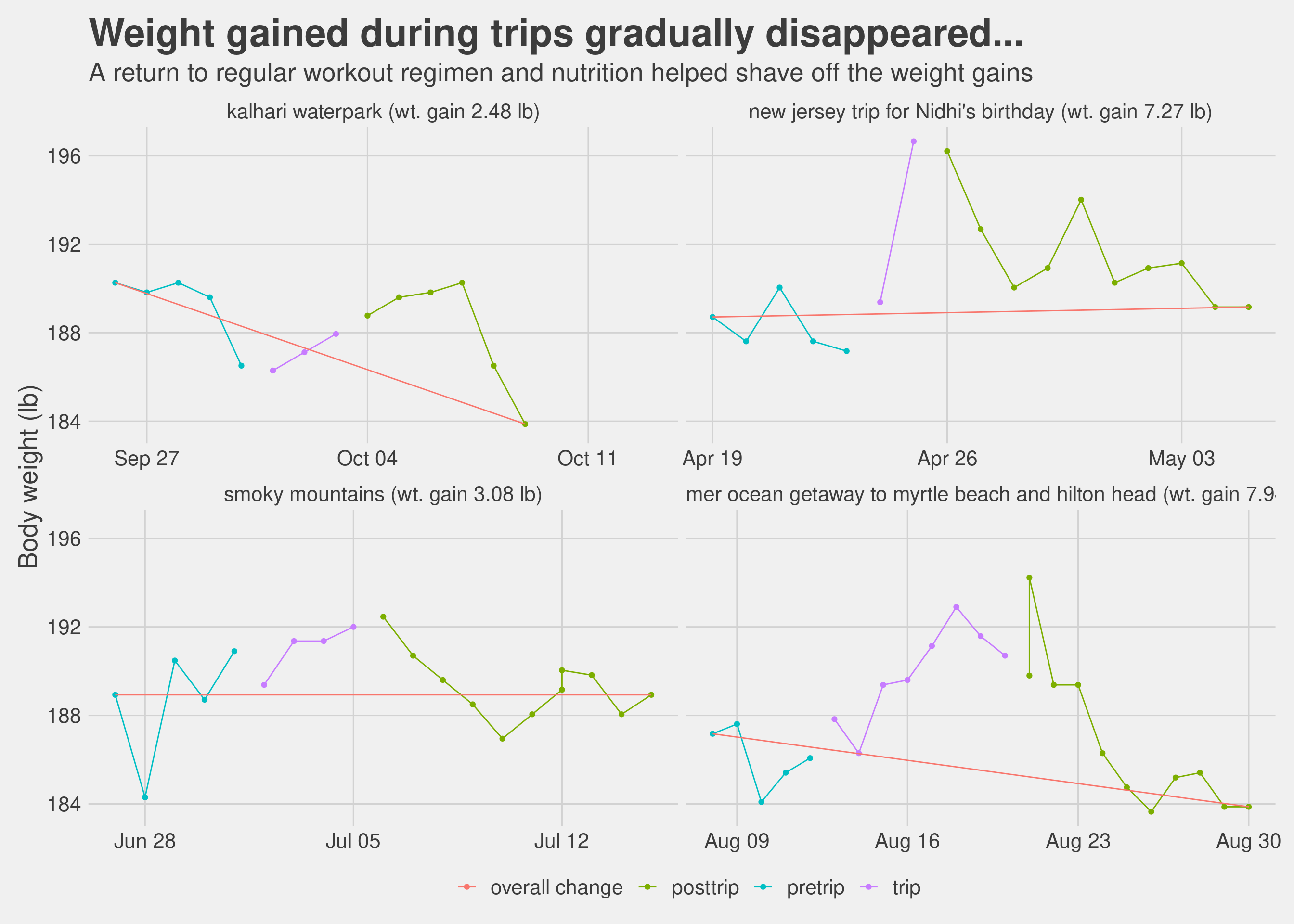
I usually like to think about each trip in terms of a weight budget like a financial budget, I know I am going to add some pounds, but how much is it that I am OK with? Usually this number should not exceed 3lbs, certainly not more than 4lb. This is the number of pounds I am confident that I would be able to shake off in a week or less after returning to my regular routine after the vacation. Yes, I travel with my weighing scale. Knowledge is power, so knowing how much of my budget have I spent (pounds gained in this case) helps keep the eating in check especially towards the end of the trip.
Upon returning from the trip, the one thing that I consciously decide not to do is to feel guilty about adding those pounds. I enjoyed the trip and the food was a part of it. In fact, it was one of the sources of enjoyment and now I will be enjoying losing this added weight. I tell myself that I understand how my body works and have the good sense to get back to eating healthy, before I know it, the added pounds would be gone. Another thing that I never do is to go on a fast or completely cut out carbs or fat after the vacation. It is neither required nor recommended, in fact, it could cause more harm than good. Suddenly going off carbs would most certainly lead to increased hunger, brain fog and irritability.
Since this book is all about data (in addition to being all about fitness), so what does the data tell us about gaining weight during trips and then losing the pounds upon returning? Well, for one, there were trips where I certainly gained more than the 3 or 4 pounds, I was comfortable with, but thankfully, I was able to get rid of the extra weight quickly upon return. No magic potion or starvation just return to regular workouts and healthy eating plus I do consciously try to be as physically active as possible during the trips. All hotels usually have a fitness center and I make good use of that. I usually do body weight or free weight (dumbbell) workouts during trips and it works out OK (the results speak for themselves).
7.7 Chapter 7: At a glance
Food composition changes as the extra weight comes off and the demands of the workout increase. I eat less protein than before and regular Indian food (daal, roti, sabzi) for dinner.
We choose eating two big meals a day rather than multiple small meals through the day. Skipping the breakfast helps with intermittent fasting.
The lunch is still a protein, fiber and a good fat rich salad. Avoiding carbs at lunch time helps avoid the lethargic feeling during the afternoon.
Dinner now has a higher carb content than before (please do not delay dinner beyond 7:30pm) which helps with a good night sleep and fueling the workouts the next morning.
A consistent regimen of the workout and healthy eating helps shave off the extra pounds from the social gatherings and vacations.