On AI: three ideas that are informing my thinking
David Deutsch, Sayash Kapoor and Arvind Narayanan, Terence Tao · October 2026
Last week, at dinner with colleagues, a sidebar conversation turned to the big picture on AI. It made me write down ideas I had picked up over time.
Fair warning: everything here is my own interpretation of what I read. Any misreading is mine alone.
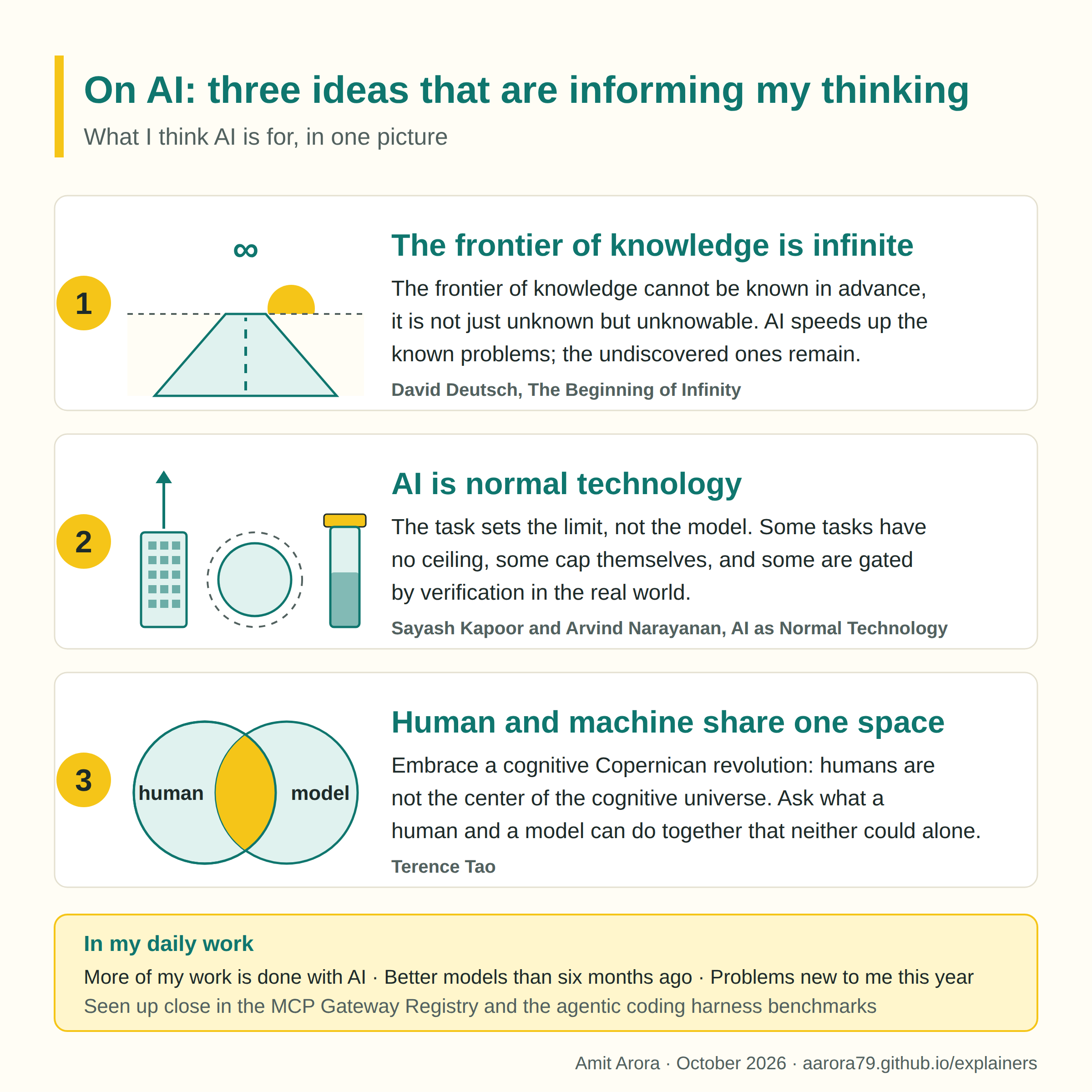
1. The frontier of knowledge is infinite
This comes from David Deutsch's The Beginning of Infinity. The frontier of knowledge cannot be known in advance, it is not just unknown but unknowable, so we cannot run out of interesting problems to solve. AI speeds up how fast we solve the known ones, and an infinite set of undiscovered ones remains.
From my work. A year and a half ago, when MCP was just getting traction, I had a hazy idea of one gateway in front of many MCP servers. The MCP Gateway Registry started there. Building it turned up problems I did not start with: path-based routing, virtual MCP servers that mix tools from several servers, interop with other registries. The backlog is growing faster than we can close it.
2. AI is normal technology
This is Sayash Kapoor and Arvind Narayanan's framing. As I read it, the task sets the limit on what AI can do, and tasks come in three kinds.
- Some have computational limits, where more compute and better models buy better performance.
- Some have fundamental limits that a better model cannot exceed.
- Some are gated by verification in the real world, which no model improvement can skip.
From my work. The agentic coding harness benchmarks plot quality against cost across harnesses and models. The Pareto frontier moves when a better model ships. Much of the result still comes from the harness, the task, and whether the tests pass.
3. Human and machine intelligence share the same space
This comes from Terence Tao. He suggests we embrace a cognitive version of the Copernican revolution: the old picture had human intelligence at the center of the cognitive universe, and now other "planets" of intelligence are appearing, comparable to our own. Human and artificial intelligence sit in the same ontological category, with differences and complementarities. The question becomes what a human and a model can do together that neither could do alone.
From my work. The benchmark uses the registry repo as one of its task sets, so the two projects meet in one place. On the registry, coding agents triage the issue backlog, review pull requests and write much of the code, directed by me through skills I wrote. It is a software factory with a human in the loop, for now at least, with agents and humans working in the same space.
In my daily work
- I do far more of my work with AI now.
- I explore ideas with better models than I had six months ago.
- Some of what I work on today, I did not know existed a few months ago.
References
- Terence Tao on AI in mathematics (and beyond) — the collected views, including the helicopter image, population studies, and answers against insight
- Mathematical methods and human thought in the age of AI — Tanya Klowden and Terence Tao, March 2026; the Copernican view is section 6.4 (also on Tao's blog)
- We're gonna need a lot more mathematicians — Amit Sahai, guest post on Tao's blog, on human understanding keeping pace
- David Deutsch, The Beginning of Infinity, 2011 — unbounded knowledge growth, and why the content of future knowledge cannot be forecast
- AI as Normal Technology — Arvind Narayanan and Sayash Kapoor; the three-category argument is Kapoor's
- MCP Gateway Registry — open source, agentic-community; the project in the first and third examples
- Agentic coding harness benchmarks — open source; the project in the second and third examples
- This page — aarora79.github.io/explainers/on-ai/, the link to share