Meru मेरु
A private AI workspace on machines your company manages.
For a CTO or CIO weighing a pilot, and for a platform team weighing a managed offering. Facts, measurements and gaps, as of this release.
v0.8.0 · November 2026 · aarora79.github.io/meru
github.com/aarora79/meru
Scan for the code
The question
The data AI helps with most is the data a company least wants to send out
- A hosted assistant reads each question on its provider's servers, with the documents, mail and records attached to it.
- Each one is a data processor to assess, contract with and monitor, and its terms can change.
- Meru takes the other path. Open-weight models run on the employee's own machine, beside the data, and no model provider is in the path.
What people use
Meru.app, a desktop app on each person's Mac
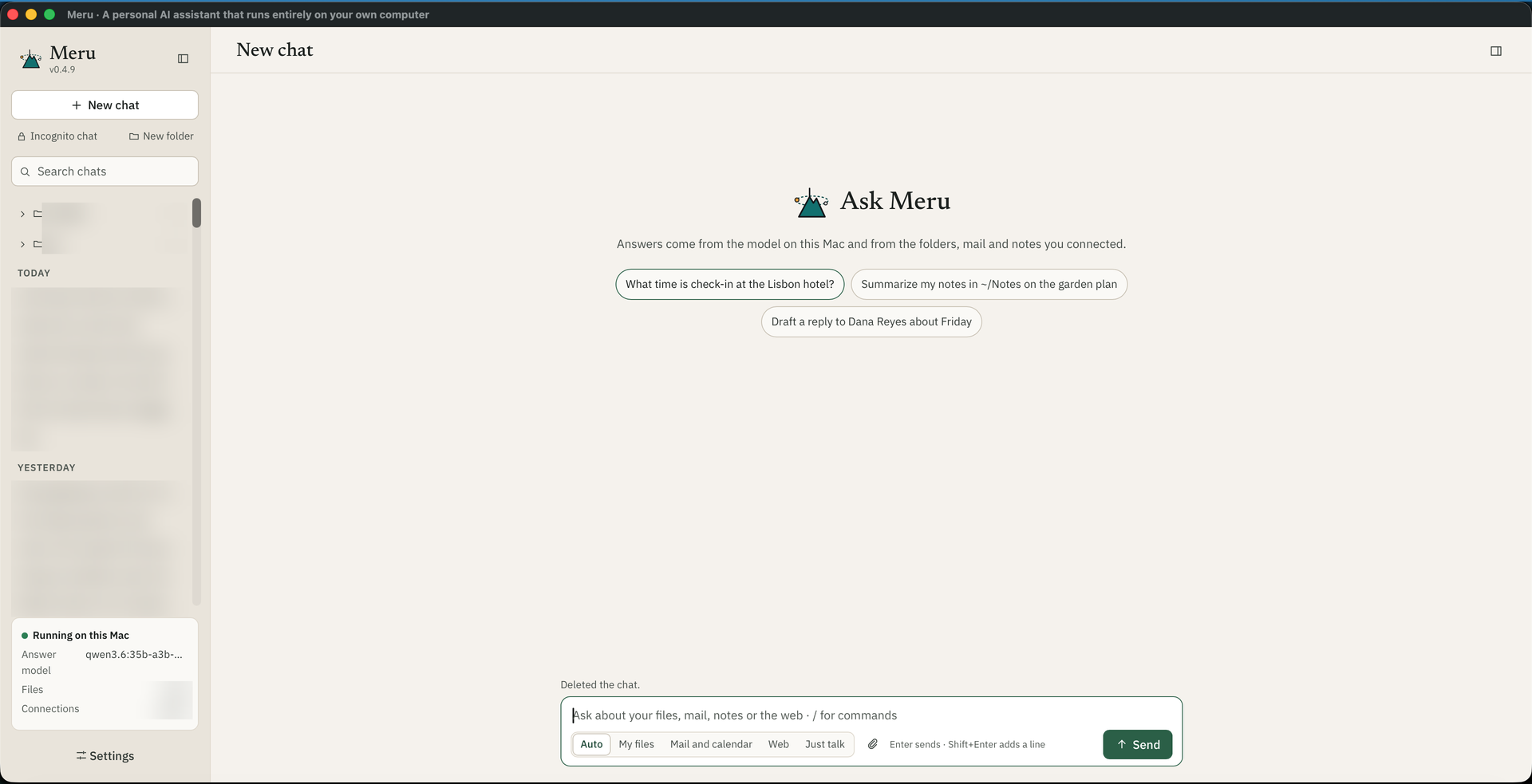
- Ask across work data: documents, mail and calendar, the web, and company systems through MCP servers the company allows, and GitHub or Slack through each person's own sign-in.
- Attach files and pictures, or speak the question.
- Approve on a card any tool call that sends, deletes or changes, before it runs.
- Settings for connections, folders, skills and models, and a Usage screen.
The app talks to merud, the program that runs the models through a local model server on 127.0.0.1, Ollama today, and owns the data; meru chat in a terminal and meru run --json for scripts talk to the same merud. No question goes to the internet, and none leaves the machine unless the company names a model on its own network and the user says yes; a test in CI fails the build on a provider's SDK or address. Apache License 2.0, written in Go, v0.8.0 in November, seven weeks after the first commit on 23 September 2026. macOS on Apple silicon first; Linux and Windows supported.
The boundary
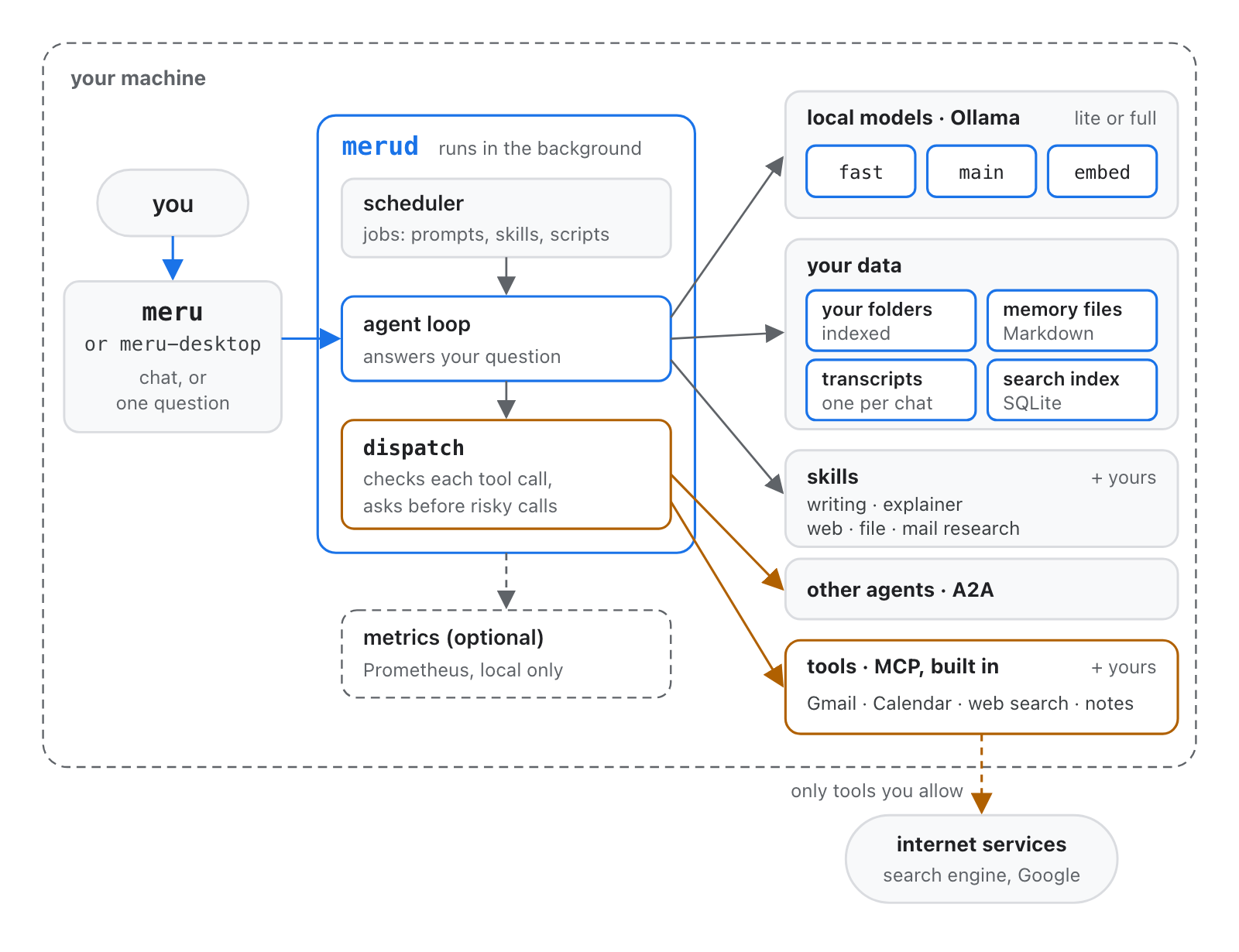
Everything inside the dashed line runs on the employee's machine
The models, the search index, the chat history and the memories stay there. Only tools the configuration allows reach outside.
Architecture
Inside merud: two ways out, each one place in the code
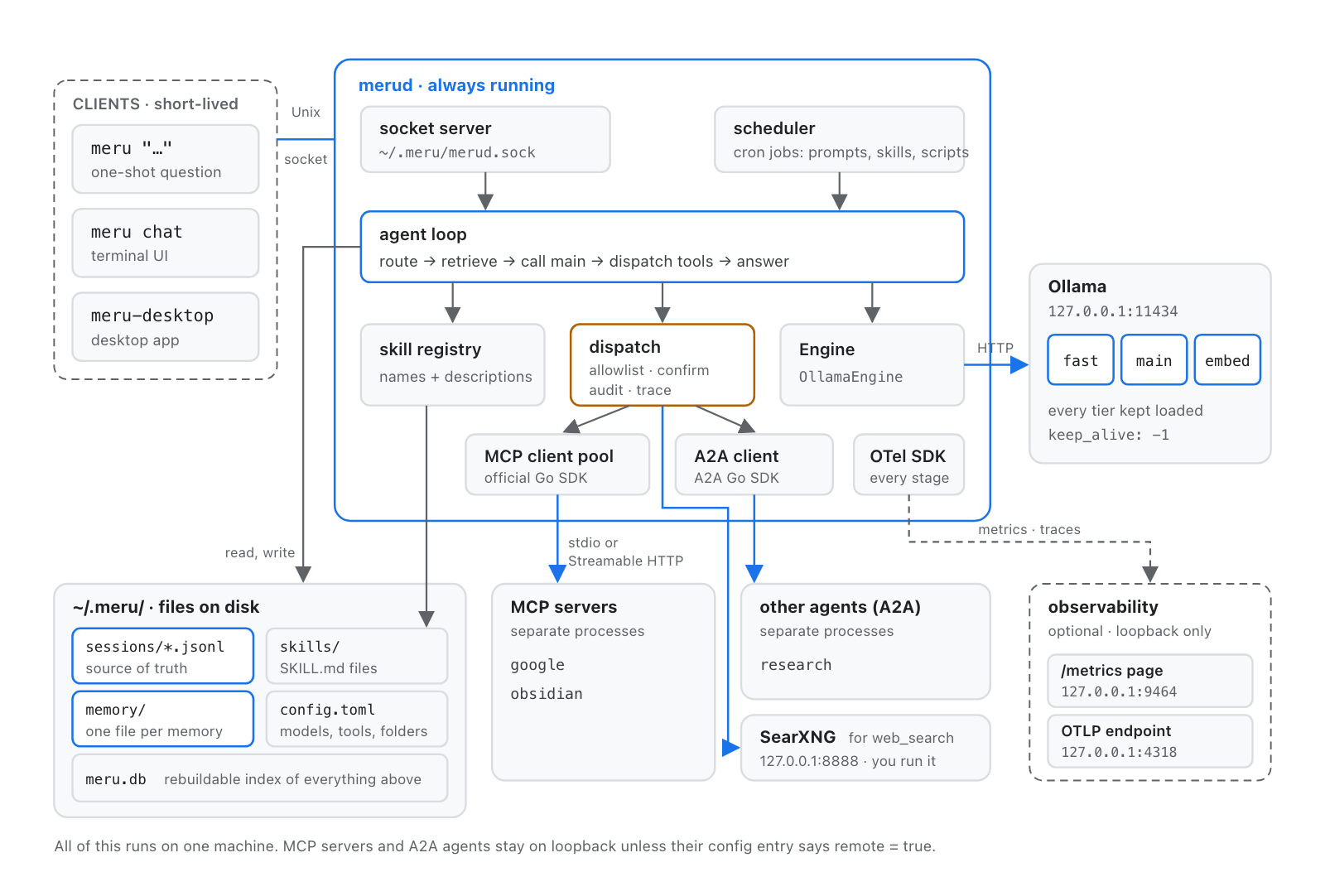
- Clients start, ask and exit.
merudruns all day and listens only on a Unix socket in~/.meru. - To models: the Engine, to Ollama on
127.0.0.1:11434, with every model kept loaded. - To tools:
dispatch, to MCP servers, A2A agents, declared commands and SearXNG. A server off the machine needsremote = true. - Files are the record.
meru.db, mode 0600, rebuilds from them. - Metrics and traces go only to 127.0.0.1;
merudrefuses any other address.
Not drawn: the connector supervisors, and the headless Chrome behind a proxy in merud for pages that need JavaScript.
Architecture
One question, end to end, and the check at each step
| Step | What merud does | Limits and checks |
|---|---|---|
| Ask | The client sends one JSON line over the socket: the question, its scope, any pictures. | Local socket only; 4 MiB per message. |
| Record | Appends the question to the session's JSON Lines transcript. | An incognito chat stays in memory and writes no file. |
| Route | The fast model writes one letter, A to D, with a confidence. With routing on, it answers a sure greeting or reword itself, and starts sooner. | Below 0.45, Meru searches and allows tools anyway. About 30 ms. A question of fact never goes to the fast model. |
| Search | Keyword (BM25) and vector search, 50 each, merged by reciprocal-rank fusion; memories and past-chat summaries too. | Listed folders only; secrets, hidden files and symlinks skipped. Top 10 go in, numbered for citation. |
| Prompt | Builds the prompt within a budget, stable parts first so the model server reuses its cache. | History: the last ten turns, cut to 8,000 characters. |
| Rounds | The answer model asks for tools; merud runs each round's calls side by side. | At most 8 rounds, the last with no tools; 8,192 tokens per model call; 5 minutes per turn. |
dispatch | Checks the allowlist and the scope, asks for approval when config says so, runs the call, logs it. | No wildcards; 60 s per call; secrets stripped; the model reads 16,000 characters of a result, the log keeps 4,000. |
| Answer | Streams to the client, checks for claims no tool backs, appends the answer with its token counts and trace ID. | A note on an action no tool took, a file never written, or an amount nothing read. |
Data flow
What leaves the machine, and what doesn't
| Data | Where it goes |
|---|---|
| Questions and answers | Nowhere, by default: the models run on the same machine. An answer model the company names on its own network gets a question only after the user says yes; none goes to the internet. |
| Files and documents | Indexed into a SQLite file on the machine; read live, never copied out. |
| Telemetry, crash reports, update checks | One anonymous count a day, with no ID and no text; [usage_report] send = "off" in pushed config stops it. No crash reports and no update checks. Metrics go to a Prometheus the company runs on the same machine. |
| Web searches | The search words go to the engines the company's own SearXNG asks. |
| Web pages | Public addresses only. Meru asks first for an address no search or question gave, unless the user trusted that website. |
| Mail and calendar | Read through the user's own account, when they connect it; Google today. |
| Company systems | SharePoint, Confluence and the like through an MCP server the company allows, tool by tool; GitHub or Slack through the user's own OAuth sign-in. Meru reaches those servers and their sign-in, nothing else. |
Controls
Controls a security team can check
| Control | How Meru does it |
|---|---|
| Tools | Deny by default. A new tool server contributes nothing until config names its tools. Each tool is Off, Ask or Allow; sending, deleting or changing asks every time. |
| Network | Connects only to its own machine, except to servers marked remote and to public pages it reads; refuses private addresses at connect time. |
| Secrets | API keys in one file only the user can read, kept out of the model; each shows as [secret:name] in logs, spans and server errors. OAuth tokens sit on the machine per user and server, owner-only, and never reach a log. |
| Supply chain | Every program Meru installs is pinned by version and SHA-256 or image digest; CI signs a record of how its speech server was built. |
| Answer checks | A note under an answer that gives an amount nothing the turn read, or claims a file or an action no tool made. |
| Enforcement | Policy tests in CI fail the build on a provider's SDK or address, a second path to a tool, or a forbidden import. |
Audit
Every tool call leaves a record on the machine
- One path for every tool call. MCP servers, other agents, local commands and built-in tools all go through
dispatch, which checks the allowlist, asks for approval, and logs the call. - Two records. A
tool_callsrow with the tool, time, duration, outcome and approval, and the session's transcript, a plain JSON Lines file. - Incognito keeps the audit row. An incognito chat keeps no transcript, and its rows keep no arguments or results, but each call is still counted.
- Metrics and traces in OpenTelemetry, to a collector on the same machine only. Prompt and answer text stay out of traces unless config turns capture on.
Measured
Answer quality and speed by Mac memory
| Mac memory | Answer model | Passed | First word, median | Whole answer, median |
|---|---|---|---|---|
| under 32 GB | MiniCPM5-2B | 68% | 11.6 s | 13.1 s |
| 32 to 47 GB | gemma4:26b-a4b-it-qat | 80% | 17.6 s | 18.3 s |
| 48 to 63 GB | qwen3.6:35b | 89% | 5.6 s | 10.4 s |
| 64 GB or more | qwen3.6:35b-a3b-mxfp8 | 89% | 4.1 s | 6.5 s |
150 results per model set, 3 runs of 50 questions about the author's own files, notes, mail and calendar, which aren't published. Times include routing, search and tool rounds. Your numbers on your data will differ. Source: docs/benchmarks/results.md, 28 September 2026.
Sizing
What the hardware has to hold
Memory, as the model server loaded it
qwen3.6:35bwith a 262,144-token window: 28.8 GB- The same model at 32,768 tokens: 23.4 GB
MiniCPM5-2B, the fast model: 2.8 GB- The search model: 0.7 GB
What follows
- A 64 GB Apple silicon Mac runs the full set with room to spare.
- On Linux and Windows, setup reads an NVIDIA card's memory: an L40S card with 45 GB got
qwen3.6:35b. - Under 32 GB, Meru runs the 2B model and passes fewer questions.
- Meru sizes each answer model's window to fit an eighth of memory.
- The answer model wrote 84 to 93 tokens a second on an M4 Max.
Rollout today
What it takes to put Meru on a machine
- A Mac installer on a disk image sets up the model server, web search, folders and
merudin eleven steps in a window. A one-line installer does the same in a terminal, and on Ubuntu a second one adds the desktop app and a systemd service. - One config file per person,
~/.meru/config.toml: the models, the folders, the tools and what each may do. - Updates are manual. Meru never checks for them, so the company decides when a new version reaches each machine.
- Files are the source of truth. The database can be deleted and rebuilt from the transcripts, memories and config.
Compared
Meru and Meta's Muse
Both give each person an agent of their own. Muse runs it in Meta's cloud; Meru, on a machine the company controls.
What Meru gives the company
- No AI processor. No question or document reaches a model provider, so there is no vendor to assess and no training opt-out to police.
- The data stays in the company's boundary: on its Macs, or on GPU machines in its own cloud account. End the machine and the data goes with it.
- Runs disconnected once the models are down, for isolated and classified networks.
- The company picks the model, pins it by digest and keeps it; it changes when the company says.
- Deny by default, set in config: each tool Off, Ask or Allow, and an approval card before any change.
- An audit row for every tool call on the machine, and metrics to the company's own collector.
- Free under Apache 2.0, with the source open to review. The cost is hardware, not seats.
What Muse offers that Meru doesn't
- Meta's newest models, Muse Spark and Muse Wonder
- Errands across the web: browsing, forms, bookings, and payments through partners such as Stripe
- Apps for phone, web, macOS and glasses
- No hardware to buy or run
For a regulated company
- Meta is the data processor; encryption that keeps Meta out is promised for later in 2026
- Consumer and small-business plans, in the US
As of October 2026. Sources: about.fb.com/news/2026/09/introducing-muse-personal-ai-agent; en.wikipedia.org/wiki/Muse_(AI_agent).
Compared
Meru and OpenClaw
Both are open source and run on your own machine. Meru narrows what the model can reach; OpenClaw opens the machine to it.
What Meru gives the company
- No hosted models. A model on the company's own network gets a question only when config names it and the user says yes.
- No shell. The model runs only commands declared whole in config, filling typed blanks.
- One audited path. Every tool call goes through
dispatch: allowlist, approval, atool_callsrow. - Deny by default, no wildcards. A tool server adds nothing until config names its tools.
- Nothing to expose.
merudlistens only on a local socket; no gateway faces the network. - Pinned installs. Every program it installs is pinned by version and SHA-256 or image digest; no public skill market in the path.
- A guard on data in links: a page the model wants that no search or question gave asks first.
What OpenClaw offers that Meru doesn't
- Any model, including hosted ones such as Claude and Codex
- WhatsApp, Slack, Teams, Signal and 20 more chat apps
- Apps for macOS, Windows, Linux, iOS and Android
- A large community: a foundation and 247,000 GitHub stars
For a regulated company
- Tools run on the host; the sandbox is optional and off by default
- Skills come from a public registry; Cisco found a top-ranked one that sent data out
As of October 2026. Sources: github.com/openclaw/openclaw; en.wikipedia.org/wiki/OpenClaw; blogs.cisco.com/ai/personal-ai-agents-like-openclaw-are-a-security-nightmare.
Gaps
What Meru does not do today
For a fleet
- No central console to push config or policy
- No single sign-on or directory link; each person signs in to each OAuth server
- Ready-made connectors only for Google and web search; GitHub and Slack need an app the company registers once; SharePoint or Confluence need an MCP server
- No central log collection: metrics and traces stay on the machine by design
- One person per machine; no shared server
For the project
- Pre-alpha, v0.8.0
- One maintainer; outside contributions merged in October and November 2026
- Digests and notifications, due in v0.7, not built yet
- Windows tested on one server; web search and connectors there need more work
For a platform provider
What a managed offering around Meru would have to add
Fleet setup and config
Install, update and push config.toml with each team's allowlists, as the company's device management already does for other programs.
A model catalog
Open-weight models chosen per hardware tier, pinned by digest and served from a mirror the company controls.
Hardware
Apple silicon Macs or GPU machines with enough memory per person, on desks or in the company's own account; the boundary holds wherever the machine is.
Connectors and audit
MCP servers for the company's own systems, OAuth apps for GitHub or Slack registered once, and a collector the company runs on each machine to gather the audit rows Meru keeps there.
The Apache License 2.0 allows this. Meru's core stays local by design: no cloud model, one anonymous daily count the company can turn off, deny by default.
For a CTO or CIO
A four-week pilot with ten people
| Week | What happens | What to look at |
|---|---|---|
| 1 | Pick ten people with Apple silicon Macs of 32 GB or more, or Linux or Windows machines with an NVIDIA card of 27 GB or more. Install, add their work folders, connect one system. | Install time; the controls table checked against the config |
| 2 and 3 | They use it for real work: questions on their documents, mail, company systems and the web. | The Usage screen: questions, routes, answer times, tool calls by outcome |
| 4 | Security reviews the tool_calls rows and the network rules; the ten say what worked. | Pass or fail against the company's own criteria |
Built in the open
The code, the design documents and every decision are in the repository.
We're happy to take contributions: see the issue list. Questions and pilots start there too.
github.com/aarora79/meru · aarora79.github.io/meru
github.com/aarora79/meru
Scan for the code