Meru मेरु
How it's built, and how to build it with us.
In some Eastern traditions, Meru is the cosmic mountain that the sun, moon and stars turn around.
v0.8.0 · for developers · November 2026
github.com/aarora79/meru
Scan for the code
The project
A local AI assistant, written in Go, built in the open
Two programs
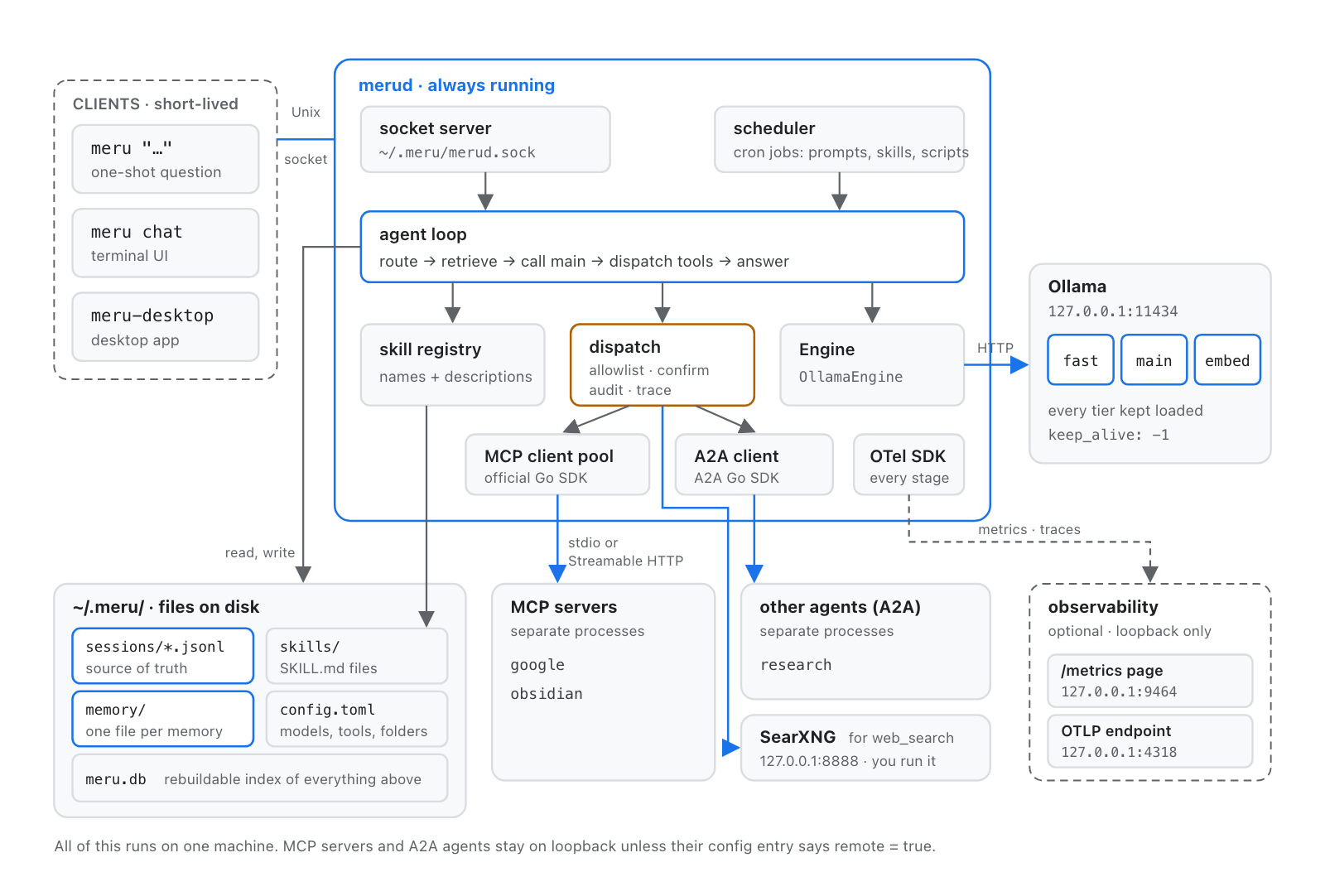
merud, a daemon that keeps models warm and does the work, and meru, a thin client over a Unix socket.
Three clients
meru "…" for one question, meru chat in a terminal, and Meru.app, a Wails v3 window.
Local models
Ollama on loopback runs the router and search models always, and the answer model unless you name one on your own network.
Why Go
Single native binaries with no cgo in merud, cheap goroutines for a daemon, and code a Python developer can read.
The size
34 internal packages, 6 commands, a coding note per package and 31 notes on Go itself.
The licence
Apache 2.0. Nothing for sale, anywhere.
How we decide
Simple wins every time
- When two designs both work, pick the one with fewer moving parts.
- A function beats a type. A struct beats an interface. An interface appears with its second implementation.
- One way to do each thing: one
dispatchpath, one store, one config file. - No speculative flags, options or plugin points.
- The standard library first, boring libraries second.
- Add complexity only when a measurement or a second real use asks for it, and say which in the PR.
- Write for a reader new to Go: every package, file and function explains itself.
ARCHITECTURE.mdis the contract; change it before the code.
The rules that don't bend
Five non-negotiables, enforced in CI
| Rule | What it means in code |
|---|---|
| No prompt leaves without a yes | Only an answer model you name may run on your own network, after "this time" or "this chat". No provider SDK or address in code. |
| One anonymous daily count, no other telemetry | Seven fixed fields with no ID, sent only by internal/usagereport after a client shows the notice. OpenTelemetry exports to loopback only; no update checks, no crash reports. |
| Deny by default | A new MCP server or A2A agent offers nothing until config allowlists it. |
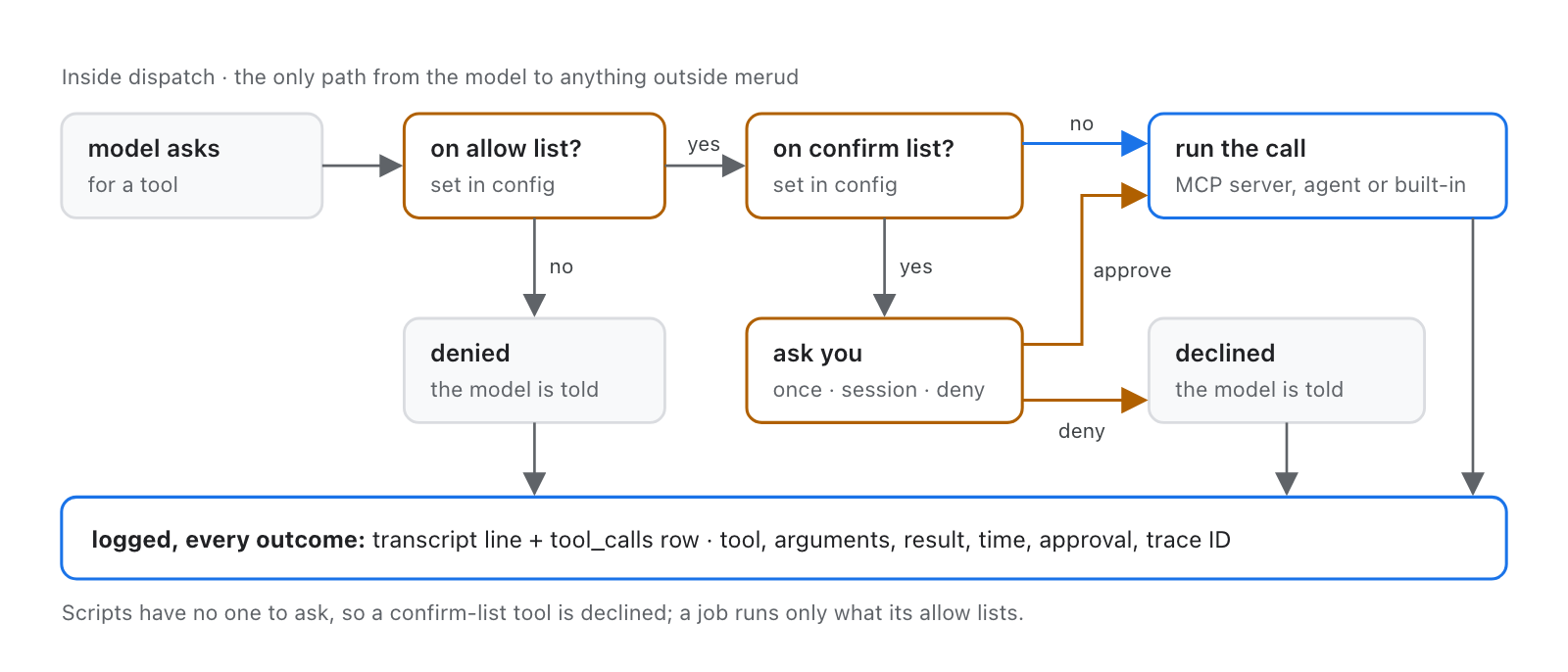
Every tool call through dispatch | One path logs each call to tool_calls and the transcript. Never a second one. |
| Nothing for sale | No pricing, paid licence or sponsor link anywhere in the project. |
internal/policy holds the tests: deny-lists of hosts and imports, allowed URLs, and the thin-client rules.
Architecture
A daemon, thin clients and files you own
merudowns the models, the store, the tools and the agent loop.- Clients hold no model or store logic, and policy tests keep it so.
- Files under
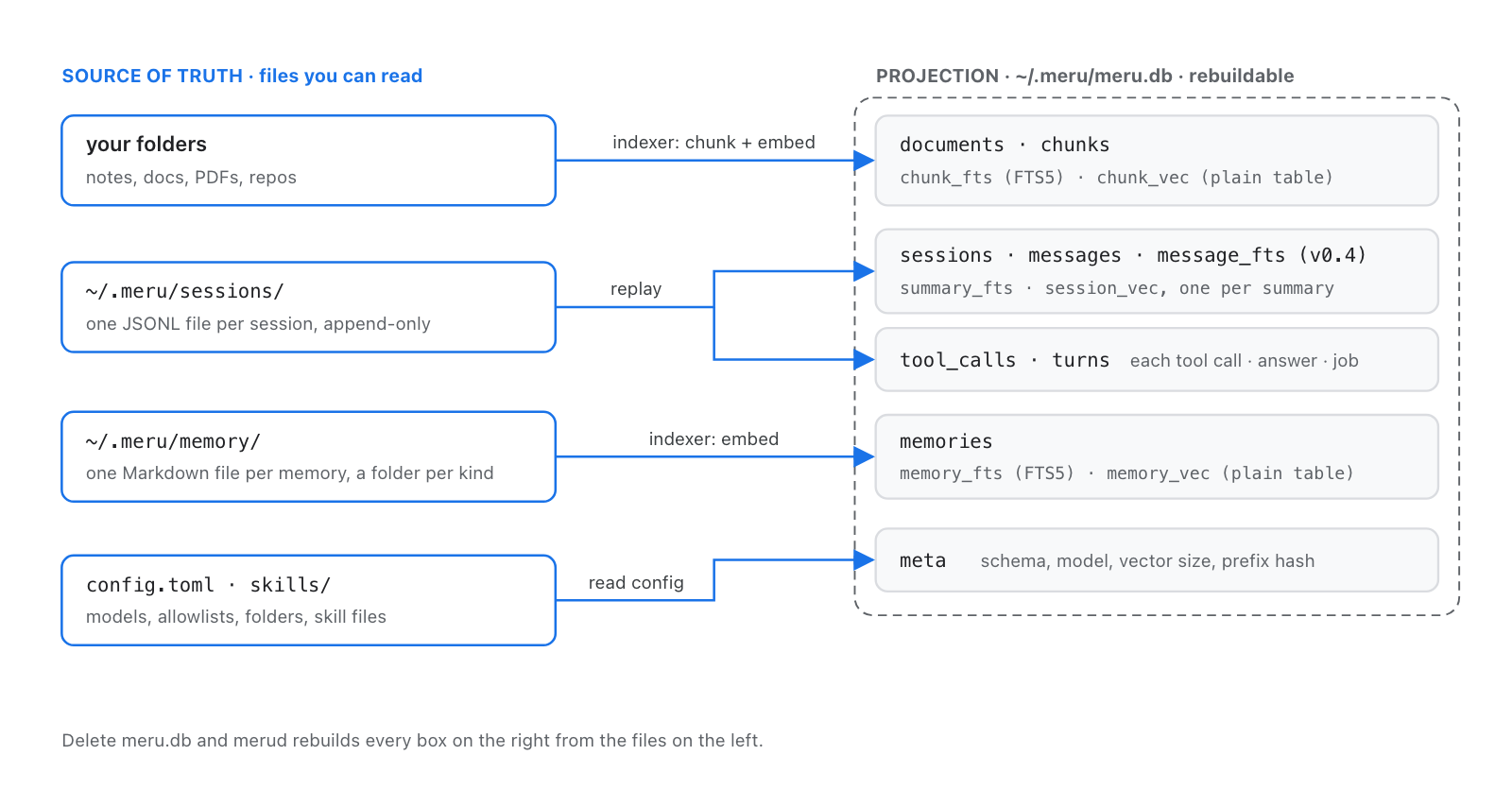
~/.meruare the truth;meru.dbis a rebuildable index.
The harness
One question, end to end, in merud
- RequestOne JSON line on the Unix socket: the question, its scope, any pictures.
- HistoryThe session's last turns, trimmed to fit.
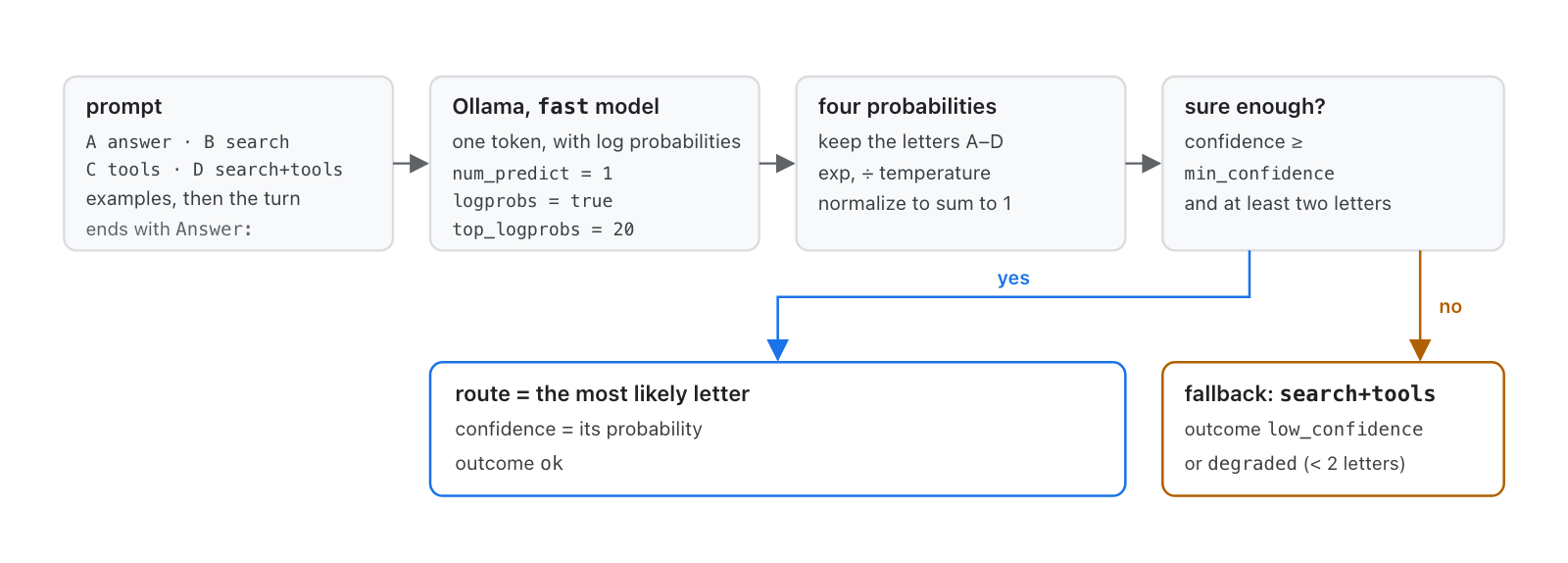
- RouteThe fast model picks one of four routes with one token, and which model answers.
- Search firstFiles, memories and past chats; the web when the question asks for it.
- PromptBuilt within a budget, stable parts first; a question about your own life lists each source to check.
- RoundsThe answer model calls tools, up to 8 rounds, the last with none.
dispatchEach call allowed, fenced, approved, logged.- AnswerStreams to the client; notes an action no tool took, a file never written, an amount nothing read.
A hand-written loop with no agent framework. A picked skill, such as mail-research for Gmail, joins the prompt. docs/architecture/harness.md walks it function by function.
Routing
A router that writes one letter
- The fast model writes one of four letters; its log probabilities give a confidence.
- With
answers = "routed", the fast model takes a sure greeting, thanks or reword. A short answer goes again to the main model; a question of fact never goes fast. [models] largeanswers only on request, with/large.
Retrieval
Search by meaning and by words
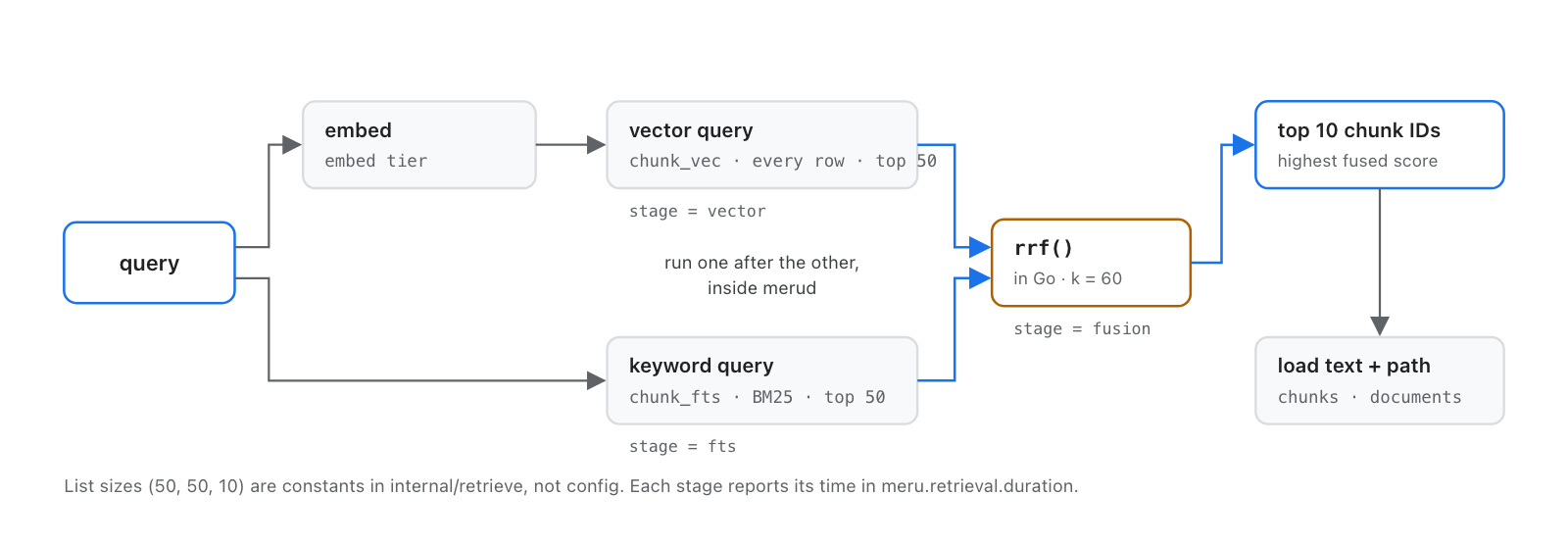
- Vectors and BM25 keyword search, 50 each, merged by reciprocal-rank fusion.
- SQLite through
ncruces/go-sqlite3: no cgo, with vec1 and FTS5 bundled. - Text and images in one 768-number space with EmbeddingGemma 2.
Tools
dispatch: the one path to a tool
- MCP servers, A2A agents,
[[commands]]and 19 built-in tools. - Allowlist, scope fence, approval (once, session, deny), audit, metrics.
- An incognito chat still gets a
tool_callsrow, with no arguments or result. write_fileputs the local pictures an HTML page names into the page.
Connectors
Meru installs and runs the servers it needs
- A manifest per connector, compiled into
merud: Obsidian, Google, SearXNG, Ollama and Whisper. - Every pin is exact: package versions, image digests, SHA-256 per download. A policy test refuses
latest. - A supervisor per connector installs on enable, starts on use, stops when idle, and backs off after a crash.
Five kinds
stdioandhttp: MCP serverscontainer: SearXNG in Docker or Podmanservice: a program speaking plain HTTP, such aswhisper-serverdependency: Ollama, watched, never installed
Connectors
Signing in to MCP servers on the internet
auth = "oauth"on a remote entry. With noclient_id, Meru registers itself; GitHub and Slack need an app you register.- The
mcp_sign_inop runs PKCE (S256) through the MCP Go SDK. A loopback callback takes one GET; the SDK checksstate. - The token sits in
~/.meru/oauth/<server>.jsonat 0600. No token, code or link reaches a log, a span or an error: each failure becomes a fixed sentence. - A tools turn sends
sign_in_needed: a Sign in button in the app,/signininmeru chat,meru mcp login.
One entry in config.toml
[[mcp.servers]] name = "github" url = "https://api.githubcopilot.com/mcp/" remote = true auth = "oauth" allow = ["get_me", "search_issues"] [mcp.servers.oauth] client_id = "Ov23li..." client_secret = "secret:github_client_secret" issuer = "https://github.com/login/oauth" scopes = ["repo", "read:user"]
OAuth requests use https only, with no redirects and no proxy.
Storage
Files are the truth; the database is an index
- JSONL transcripts, Markdown memories, one
config.toml. - Delete
meru.dband Meru rebuilds it. - A new embedding model drops vectors, keeps text, and re-embeds.
Observability
Measured, and the numbers stay home
- OpenTelemetry metrics and traces for every stage, exported to loopback only;
merudrefuses any other endpoint. - A
/metricspage for a Prometheus you run, and a Usage screen in both clients, drawn frommeru.db. - Question and answer text stay out of spans unless
capture_content = true. - One redactor shows each stored secret as
[secret:<name>]inmerud.log, spans and server errors.
Some of the metrics
meru.turn.durationby route, source and outcomemeru.route.decisions: how often the router is unsuremeru.tool.callsby kind, server, tool and outcomemeru.retrieval.durationby stagemeru.speech.durationby model and outcome
Attributes come from small fixed sets: never IDs, paths or text.
A worked example
Voice in a day: measure first, then build
The test
- Gemma 4 in Ollama heard well, but at 7.4 GB pushed a model out: about 5 s to a spoken question's first word.
- As a chat model it answered "explain why the sky is blue" instead of writing it down.
- Whisper: 445 to 890 MB in its own process, under half a second for 26 s of speech.
The build, six PRs
- Design in ARCHITECTURE.md first
- CI builds
whisper-serverfrom pinned source, with a build attestation - A
serviceconnector kind, behind a random path per start - A
transcribeop, then the microphone in Meru.app
How we work
Every change carries its docs and its checks
Contract first
Change ARCHITECTURE.md, then carry it into the 300, 200 and 100 pages and their figures.
Explain the code
A PR that changes a package updates its note in docs/coding-notes/, or it doesn't merge.
make check
Format, vet, staticcheck, race tests, end-to-end tests, five-platform builds, govulncheck, gosec, gitleaks.
Reviewed by personas
The pr-review skill reads each PR as security, SRE, Go and architecture reviewers.
Plain prose
Docs, comments and commit messages follow the writing skill: short words, active voice.
Releases
make release builds, checks and publishes; release notes come from a skill.
Contribute
We build in the open, and we're happy to accept contributions
Get going
git clone https://github.com/aarora79/merumake checkgo run ./cmd/merud and go run ./cmd/meru "hello"
Read AGENTS.md, then docs/lld.md, then the coding note for the package you touch. CONTRIBUTING.md has the contributor agreement.
From the issue list
- #150 Live transcription
- #87 Third-party MCP servers that Meru installs and heals
- #235 Find AMD cards, not only NVIDIA
- #85 Web search and connectors on Windows
- #77 Python examples of
merudas an agent harness
The first outside contribution, #139, merged in October.
Come build with us
Your assistant, your machine, your data.
We build in the open, and we're happy to accept contributions: see the issue list on GitHub.
github.com/aarora79/meru · aarora79.github.io/meru · Apache License 2.0
github.com/aarora79/meru
Scan for the code